
AUTHOR: Bewise-Admin


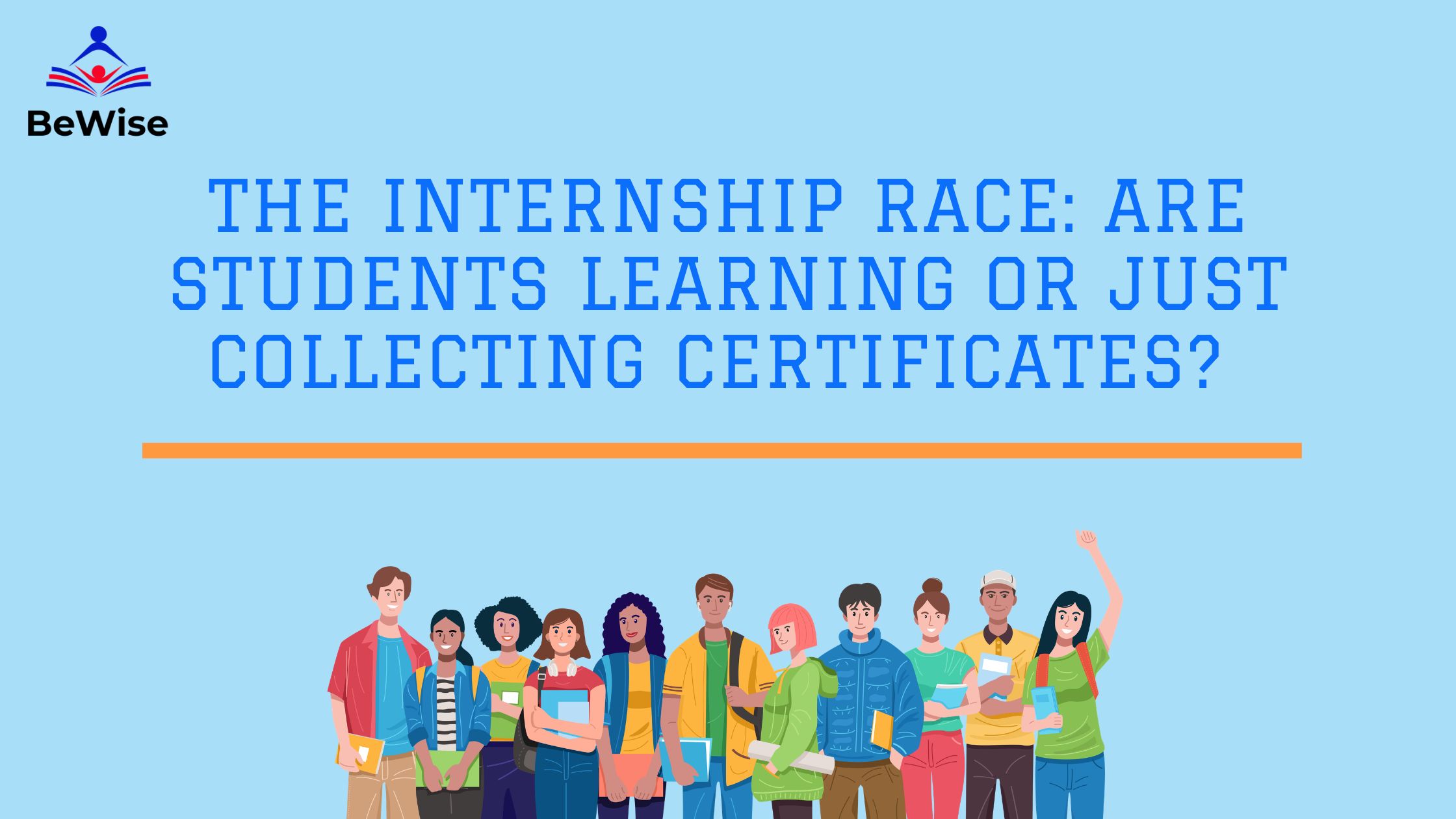
At some point in the last few years, something has shifted.
Internships stopped being something students did to learn. They became something students did to be seen doing.
Open LinkedIn on any given day and you'll find a stream of "Excited to announce..." posts, completion certificates, new badges, fresh role titles. Everyone appears to be building, achieving, moving forward. And somewhere in the middle of scrolling through all of it, a quieter, more uncomfortable question starts to form.
Are students actually learning anything? Or has the internship become just another box to tick before someone else ticks it first?
There was a time not that long ago when an internship was considered a bonus. A chance to see how the real world worked before you entered it. Something the more proactive students pursued, not something every first year felt quietly panicked about.
That time has passed.
.jpg)
Today, students arrive at college already feeling behind. There's an unspoken belief that without a competitive profile, built early, updated constantly, visible publicly, opportunities will simply pass them by. The pressure isn't coming from nowhere. Employers genuinely value experience over credentials alone. Degrees aren't enough anymore, and most students know it.
But the pressure has overshot the reality. And somewhere between genuine ambition and social comparison, the internship became a source of stress rather than growth.
Part of what's driving this is how career-building looks on the outside versus how it actually feels on the inside.
On social media, everyone seems to be in perpetual forward motion. Someone is always joining a startup, earning a new certification, collaborating with international teams, or launching a side project. It looks relentless and effortless at the same time. And students, who are often privately exhausted and uncertain, start measuring themselves against a highlight reel that was never designed to reflect reality.
The result is that internships for college students in India, which should open doors to genuine self-discovery increasingly feel like proof of worth. Not "what am I learning here?" but "how does this look on my profile?"
That's a subtle shift. But it changes everything about how the experience is approached.
When the goal becomes appearance rather than growth, the internship itself changes shape.
Students start selecting opportunities based on how impressive the company name looks rather than what the role will actually teach them. Tasks get repeated week after week without anyone asking whether learning is happening. A certificate gets issued, and their LinkedIn profiles get updated. However, the students become technically more experienced but practically not much wiser. 
Research from the National Association of Colleges and Employers is fairly clear on what makes internships actually work: meaningful problem-solving, access to mentorship, and real responsibility. Not brand recognition and a PDF certificate.
The gap between what makes a good-looking internship and what makes a genuinely useful one is wider than most students understand.
Here's something that rarely makes it into the "Excited to announce..." posts.
A significant number of students chasing this internship culture are quietly burning out. They're managing college assignments, entrance exam preparation, internship responsibilities, online courses, networking pressure, and social obligations often simultaneously, often without adequate support, and often while performing confidence they don't feel.
The irony is sharp. Students are so busy building resumes that they don't have the time or mental space to reflect on what they actually enjoy, what they're genuinely good at, or what kind of work might actually suit them long-term. Career building has been quietly replaced by career performance.
This isn't an argument against internships. When they work, they can be genuinely formative.
Not because of the certificate. Because of what the experience forces you to figure out.
A good internship shows students how a real workplace functions, how decisions get made, how people communicate under pressure, and how feedback works when it's not filtered through an academic grading system. Students often come out of meaningful internships understanding something far more useful than any technical skill: which environments energize them, which kinds of problems they enjoy solving, and which types of work quietly drain them.
That kind of self-knowledge is more valuable than most students realize when they're in the middle of accumulating credentials. And it's exactly the kind of knowledge that employability programs for students and skill-based learning programs should be designed to develop through reflection and application, not just task completion.
There's a psychological pattern worth naming here.
Once the public announcement becomes part of the experience, the experience starts to be shaped by the announcement. Students begin optimizing for what will look good rather than what will be useful. They avoid opportunities that feel unglamorous, even when those opportunities might teach them more. They stick with recognizable company names over smaller organizations where they'd have real responsibility.

True learning is often slow, untidy, and genuinely unimpressive from the outside. It involves making mistakes in rooms where no one is watching, figuring things out without a template, and sitting with uncertainty long enough to develop actual judgment.
Most colleges actively encourage internships. Fewer of them do a good job of helping students choose the right ones.
Students need more than a list of opportunities. They need guidance around what to look for mentorship quality, the nature of actual responsibilities, alignment with long-term interests, the kind of industry exposure that genuinely builds perspective. This is where career guidance after 12th continues to matter well into college life, and where structured college-level career support could make an enormous difference.
Students aren't failing to find internships. They're failing to find the right ones and often don't know what "right" would even look like for them yet.
Something interesting happens when students step outside the local internship race entirely.
Those who pursue study abroad scholarships, semester exchange program opportunities, or international internships often come back with a fundamentally different relationship to their own career thinking. Exposure to different approaches to work, creativity, and professional culture has a way of loosening the grip of comparison-driven anxiety. Students start asking better questions about fit, about meaning, about what they actually want rather than defaulting to whatever looks most competitive on a profile.
That shift in perspective is worth more than most certificates.
This is where a platform like CollegeCampus can genuinely help not just by surfacing internship options, but by helping students approach those options with more clarity and intention. Career interest exploration, skill development support, access to quality internships for college students, and structured career direction. These matter more than the volume of opportunity.
Students don't need more stress. They need better guidance. Those are very different things.
An internship was never supposed to be a competition.
At its best, it's an experiment. A chance to test assumptions about what you think you want against the reality of what it actually feels like doing that work. To discover something about an industry, a working style, or yourself that no classroom could have told you.
The students who get the most out of their early career experiences aren't always the ones with the longest list of companies on their profiles. They're the ones who can articulate what they learned, how they changed, what surprised them, and how it shaped what they want to do next.
A certificate might get a CV through an initial filter. But a genuine experience shapes how someone thinks, works, and makes decisions for years and that's the one worth chasing.
Because employers now genuinely value practical experience, communication skills, and problem-solving ability alongside academic qualifications. Internships for college students in India have become a meaningful way to build real-world exposure before graduation.
Increasingly, yes and it's worth being honest about why. Social comparison, visible LinkedIn culture, and genuine job market pressure have created an environment where appearance can override substance. Shifting focus back toward meaningful skill-based learning programs and reflective practice is one of the more important corrections colleges can make.
Real responsibility, access to mentorship, meaningful problem-solving, and exposure to how workplaces actually function. The best internships teach students something about themselves, and not just something about an industry.
By starting with questions about learning rather than appearance. What will this role actually teach me? Does this align with what I think I want to do? Will I have real responsibilities or just repeat tasks? That framing is supported by proper career guidance and employability programs for students and consistently leads to better outcomes than chasing brand names.

Blogs


© Copyright 2023 BeWise & Wisdom Tech Solutions. All Rights Reserved. BeWise College Campus is an initiative of Wisdom Tech Solutions Pvt Ltd focused on entrepreneurship and innovation programs for higher education institutions.